I recently set up a new profile on my instagram account which concentrates on my interest in World War One, World War Two and my relevant photography... @ww1.ww2_history_photography
This blog has also included a few articles on history and my various Leger Battlefield Tours to Belgium and France and has been updated with two more trips I have made.
This updated article aims to promote those I have featured on this blog over the past few years. They are listed below with the title, date first published, an image, a short excerpt and the link to the full article.
ORADOUR-SUR-GLANE
First published 5 March 2021

Oradour-sur-Glane was a small idyllic village, with a population of around 350, located approximately 15 miles north-west of Limoges which, on 10 June 1944, was the site of one of the worst crimes against civilians in occupied France.
Following the allied landings on 6 June 1944, along the beaches of Normandy, efforts by the resistance increased with the aim to disrupt German supplies and communications. Any organised attacks against German military personnel or property was met with brutal consequences resulting in members of the French resistance or sympathizers being killed or sent to concentration camps. Field Marshal Gerd von Rundstedt, Commander-in-Chief for the West, ordered that the resistance must be crushed, swiftly and with ruthless initiative.
There has been much speculation as to why Oradour-sur-Glane was subject to such a horrific massacre, especially when no German troops occupied the village and it seemed likely that the war would pass it by. Of course, as we shall see, this couldn't be further from the truth.
A number of reasons have been given... the killing of German troops by the resistance or an attempt to blow up a bridge at the nearby village of St. Junien. However, the most common theory was the abduction and execution of SS Sturmbannfuhrer Helmut Kampfe.
Read the full article here...
-------------------------------------------------------
D-DAY LANDINGS IN NORMANDY
First published 13 June 2022

An early start saw us heading the short journey to Pegasus Bridge, originally the Benouville Bridge, the site of the first action of D-Day.
Led by Major John Howard, a force from the Oxfordshire and Buckinghamshire Light Infantry and a platoon of Royal Engineers, landed in fields close to the bridge in three Horsa Gliders at 00:16 on 6 June. The defending Germans were taken by surprise and within ten minutes the bridge was in Allied hands.
Reinforcements from the 7th Battalion Parachute Regiment soon arrived. One member of the regiment was actor Richard Todd who would go on to play the role of Major Howard in the film The Longest Day.
The bridge was renamed Pegasus Bridge in late 1944 in honour of the operation and the name was taken from the shoulder emblem worn by the British Airborne Forces, Bellerophon riding the winged horse Pegasus.
The original bridge was replaced in 1994 and is now housed in the grounds of the nearby museum along with a replica Horsa Glider.
Inside the museum you can follow the story of the capture of the bridge with hundreds of items related to that first attack including uniforms, equipment along with scores of photos and information boards.. A very interesting museum that would take several hours to read and view every item.
Read the full article here...
-------------------------------------------------------
DUNKIRK AND FORTRESS EUROPE
First published 5 August 2023
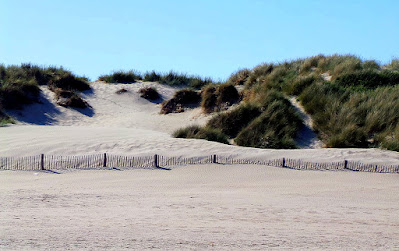
Following Hitler's invasion of France on 10 May it was only a matter of a few days before his Panzer Divisions had moved through Northern France towards the coast. The British Expeditionary Force (BEF) and French Army were trapped in a pocket and were forced to retreat to Dunkirk.
Forced back towards the coast they formed a perimeter along the canals and both the Royal Welch Fusiliers and Durham Light Infantry were ordered to defend and hold Robecq, Saint Floris and Saint Venant.
This first stop was an opportunity to see the canal area at Saint Venant defended by the Royal Welch Fusiliers and Durham Light Infantry and the memorial. We also visited the Communal Cemetery where many of those killed in Saint Venant are buried.
Moving on to Cassel Hill we examined the last stand of the Gloucestershire Regiment and the Oxfordshire and Buckinghamshire Light Infantry. They had reached Cassel on 25th May and were ordered to hold the western and eastern halves of the town. The plan was to hold the line to allow the BEF to be evacuated from the Dunkirk beaches.
Despite early success in holding the Germans back, continuous heavy air and ground attacks reduced much of the town to ruins. Most of the regiments men were either killed or taken prisoner. However, they had succeeded in delaying the German advance giving the troops in Dunkirk the much needed time to get off the beaches.
Read the full article here...
-------------------------------------------------------
WAR BY TIMETABLE
First published 26 August 2024

An early breakfast and then we set off to our first stop of the day, the Steam Railway of the Three Valleys in Belgium whose name derives from the three rivers the line follows, the River Eau Blanche, River Eau Noire and River Viroin. It is a non-profit society that operates the service which connects with the Belgian rail network at Mariembourg.
A specially arranged journey on a period steam train saw us travel the 14 kilometre journey from Mariembourg via Nismes, Olloy-sur-Viroin and Vierves to Treignes, the last station before the French border. The line does continue the 2.5 kilometres to the border but is not used anymore. An enjoyable journey with great views of the Belgium countryside from our carriage. The staff at the station and onboard the train were excellent and very helpful.
At the end of the journey there was time to look around the museum which was very interesting with its collection of various trains, both steam and electric, along with items of railway memorabilia.
Following a quick lunch, Croque Monsieur and a refreshing drink, in the cafe at the station in Treignes we headed out of Belgium and to our next stop in France.
At La Capelle we visited the memorial marking the spot where the German parliamentarians crossed the French lines seeking an Armistice on 7 November 1918.
Read the full article here...
-------------------------------------------------------
OPERATION MARKET GARDEN
First published 18 October 2025
Back in July I went on my sixth Leger Battlefield Tour...
Operation Market Garden, the September 1944 military operation aimed at
securing a number of bridges in The Netherlands. I was accompanied by my
good friend and fellow history enthusiast John Chisholm and in this article I
look back at the tour, highlighting the various sites we visited along with a
brief overview of what happened during those few days in September. I am also
including some of the many photos I took during the tour.
Operation Market Garden, which lasted nine days from 17th to
the 25th September, was General Bernard Montgomery’s attempt to end the war
before Christmas, by launching a ground offensive through The Netherlands into
Germany with the route secured by Airborne forces.
Market was the Airborne side of the operation by the 101st
and 82nd US Airborne Division and 1st British Airborne Division who would land
by glider and parachute at various drop and landing zones, with the intention
to secure the bridges along the route.
Garden was the ground offensive by the British XXX Corps who
would advance across the bridges and over the Rhine. The main bridges were at
Eindhoven, Nijmegen and Arnhem with smaller bridges at Veghel and Grave.
Although most of the bridges were captured the plan
eventually failed. The British 1st Airborne Division found itself embattled at
Arnhem waiting for XXX Corps, a battle in which only 2,000 Airborne troops
would escape out of 10,000.
Read the full article here...
-------------------------------------------------------
ALL QUIET ON THE WESTERN FRONT
First published 1 July 2026
An early start saw us heading to Folkestone where we boarded
our tour coach before taking the short journey to Dover and the ferry crossing
to Dunkirk.
We were booked in for four nights at the Hotel &
Aparthotel Alize in Mouscron, a lovely hotel with great facilities, staff and
only a couple of minutes walk from the town square, restaurants and bars. It
was also central for our planned visits over the following few days.
On our way to the hotel we made an unplanned stop at
Lijssenthoek Military Cemetery about a mile from the Belgian city and
municipality of Poperinge in the province of West Flanders.
The cemetery contains 9,901 Commonwealth burials from the
First World War with 24 unidentified. There are a further 883 war graves,
mostly French and German.
During our brief visit we visited the grave of Staff Nurse
Nellie Spindler who had joined the Queen Alexandra's Imperial Military Nursing
Service and in May 1917 went across to France. At first she was stationed at a
hospital in Abbeville before transferring to No. 44 Casualty Clearing Station
which, in July 1917, was based in Brandhoek, Belgium, close to the frontlines.
On 21 August 1917 the hospital was shelled throughout the
day and Spindler was knocked unconscious by an exploding shell. Despite efforts
to save her she died less than 30 minutes later in the arms of another nurse.
Read the full article here...
-------------------------------------------------------
Hope you enjoy the articles and please support my work and follow me here and on my instagram profile... @ww1.ww2_history_photography.
You can also add your comments here and if you have any questions or suggestions you can message me through the Contact Form on the main page of this blog.
Look out for more World War One and World War Two related articles in the future.


No comments:
Post a Comment