17 May 2023

JOHNNY CASH - THE BILLY SHERRILL SESSIONS

The 12 September 2023 marks twenty-years since we lost Johnny Cash and over the next few months I will be reprinting a few articles that I originally wrote and published in Johnny Cash-The Man in Black, which I edited and published between 1994 and 2019. In this article, originally published in Issue #84 - December 2015 although edited here with additional text and illustrations, we look back at the career of Billy Sherrill and his work with Johnny Cash.

When one thinks of Johnny Cash’s producers there are many names that come to mind. Of course high on the list is Sam Phillips, who founded Sun Records, and gave Cash his first break. Also at Sun Records was ‘Cowboy’ Jack Clement, whose name would crop up regularly throughout Cash’s career. While his move to Columbia Records saw him working with Don Law and Frank Jones and in the late 1960s Bob Johnston who was behind the legendary prison albums. Into the 1970s and we find Larry Butler and Charlie Bragg working with Cash while the following decade would see Brian Ahern and band members Earl Poole Ball and Marty Stuart taking over the role. Of course any list would not be complete without Rick Rubin who bought Cash’s music to a whole new audience in the 1990s and 2000s. One name often overlooked is that of legendary Nashville producer Billy Sherrill and in this article we look back at his career and his work with Johnny Cash.


Billy Norris Sherrill was born on 5 November 1936 in Phil Campbell a small town located in Franklin County, Alabama.

His early life was surrounded by music and he would often accompany his evangelist father at local revival meetings. He joined several local R&B and rock bands and in 1960 released a single, Rules Of The Game, on the Mercury label and several years later released the album, Country Classics, on the Epic label. 

Sherrill’s first experience as a producer and engineer was at Sam Phillip’s Nashville studio although it was a hiring by Epic Records in 1963 that was the start of his major role as a producer. Maybe because of his lack of experience he first worked with artists that other producers had declined to work with and surprisingly among these were The Staple Singers!

It wasn’t long though before he started to make an impression with country artists with David Houston’s #1 hit Almost Persuaded being one of his first major successes. Written by Sherrill with Glenn Sutton the song won two Grammy Awards for Houston - ‘Best Country & Western Recording’ and ‘Best Country & Western Vocal Performance, Male’ both in 1966. Although they did not walk away with the honour both Sherrill and Sutton were nominated in the ‘Best Country & Western Song’ category.

Sherrill had great admiration for Owen Bradley, a producer who had worked with the likes of Patsy Cline and Loretta Lynn and was instrumental in the creation of the Nashville Sound through his work at his own studios The Quonset Hut and Bradley’s Barn. It was Bradley who added strings and backing vocals to country records and Sherrill took this further with his lush arrangements that some people compared to the work of legendary rock producer Phil Spector.

Often criticised for his production the hit records speak for themselves. Jerry Kennedy, another Nashville producer once said, “His productions were always first class and as the charts indicated, he had a pretty good idea about what record buyers wanted.”


During his long career he worked with many artists including Marty Robbins, Joe Stampley, David Allan Coe, Johnny Paycheck, Johnny Cash, Ray Charles, Charlie Rich and Tanya Tucker as well as British rocker Elvis Costello. However, it is his work with Tammy Wynette and George Jones that he will be best remembered. 

Sherrill guided Wynette’s career more than any other artist he worked with. Although she had already had a minor hit in 1967 with Apartment #9 it was the Billy Sherrill and Glen Sutton composition Your Good Girl’s Gonna Go Bad that would be the first of a string of hits produced by Sherrill.

Thirty-nine top ten hits would follow with an incredible twenty hitting the #1 spot. Among these hits were, I Don’t Want To Play House, Singing My Song, Another Lonely Song, Take Me To Your World, I’ll See Him Through and, who could ever forget her biggest hit, Stand By Your Man.

With his dramatic productions and her emotional performances it helped create her image of the queen of heartbreak and a woman who survives all the romantic turmoils in her life.

Sherrill also produced many of her duets with husband George Jones including We’re Gonna Hold On, Near You and Golden Ring.

Sherrill began producing George Jones’ solo releases in the early 1970s. Having already notched up many successful hits it was under the guidance of Sherrill that he recorded some of his best records – We Can Make It, The Grand Tour and a song which Jones had originally had reservations about recording, He Stopped Loving Her Today.

In 1985 Sherrill left Columbia to further his career as an independent producer and would go on to work with many artists including Shelby Lynne.

Retiring in the early 1990s he could look back on a successful career that still continues to influence country music today as recognised by his induction into the Country Music Hall of Fame in 2010. Sherrill died in August 2015 but his legacy will live forever.

We will now take a look at his work with Johnny Cash which began back in 1980.

Cash first worked with Billy Sherrill at Columbia Studios in Nashville on 5 September 1980 where they worked on two songs, The Baron and I Will Dance With You with a second session on 30 September to overdub The Baron.

An article appeared in Cashbox (21 March 1981) about the teaming up of Cash and Sherrill and explained why it had taken them so long to work together - 'There are many interesting aspects to Columbia recording artist Johnny Cash’s latest single, The Baron, the most unique being that it marks the first teaming of Cash and producer Billy Sherrill. Although Sherrill has been producing CBS artists for 17 years, with Cash recording for CBS for 22 years, the two have never joined forces for a record. According to Sherrill, the reason for this had been that he (Sherrill) “hadn’t found the right song for John.” Sherrill added that when he and co-writers Paul Richey and Jerry Taylor completed this song, he knew it would be perfect for Cash. “We went in and quickly recorded it because we felt so strongly about it,” he said. Cash seems to concur. “The Baron is the best song I’ve heard in years,” he said. I respect Billy Sherrill very much as a producer and an album with him is a possibility."'


Released as a single in March 1981 it spent fifteen weeks on the country charts peaking at #10, his best chart position since Ghost Riders In The Sky two years earlier.

Cash was working with Jack Clement on tracks for his new album to be titled The Adventures of Johnny Cash when, in March 1981, Sherrill approached Cash about recording material to capitalise on the success of The Baron.

They recorded enough material for an album over a few days in March with most of the material picked by Sherrill although Cash did insist on recording an old folk song, Hey, Hey Train, which was arranged by guitarist Marty Stuart.

Other tracks recorded for the album included Mobile Bay, A Ceiling, Four Walls And A Floor, Thanks To You, Chattanooga City Limits Sign, The Reverend Mr Black and The Greatest Love Affair.

The album was released in May and Columbia took out a full-page ad in the music press which included the tag-line, ‘Nobody Can Beat Him…. songs and stories as only Johnny Cash can sing them.’


The album deserved to do better than its high of #24 and 12 week chart run, especially based on the title tracks success as a single and the video that was produced to accompany it. Two further singles didn’t fare much better with Mobile Bay only hitting #60 and Chattanooga City Limit Sign failing to chart.

A number of tracks remain unreleased from these sessions including Don’t You Think It’s Come Our Time, Billy Brown, New Cut Road,Why Am I Thinking Of You and Tennessee although, as we shall see later, a couple of these did finally find a release. 

Other than the live album, The Survivors (featuring both Carl Perkins and Jerry Lee Lewis) which stalled at #21, Cash didn’t place any albums on the country or pop charts between 1981 and 1985 when the Highwaymen album was released and peaked at #1.

In an attempt to rejuvinate Cash’s career and see him riding high in the charts again Rick Blackburn, head of Nashville’s country operation, teamed Cash up with Billy Sherrill once again in early 1984.

Despite the modest success of their previous work, Columbia felt that Sherrill had a new song that could turn Cash’s career around.

Unfortunately the song, Chicken In Black (originally to be titled Brain Transfusion) written by Nashville songwriter Gary Gentry, was awful and did not achieve the success everybody had hoped for.

Recorded on 12 April 1984 at 1111 Sound Studios in Nashville, Cash was backed by some of Nashville’s finest – Jerry Carrigan (guitar), Jerry Kennedy (guitar), Billy Sandford (guitar), Dale Sellers (rhythm guitar), Pete Drake (steel guitar), Hargus ‘Pig’ Robbins (piano), Henry Strzelecki (electric bass), Bobby Wood (piano) and Cash band-member Marty Stuart (guitar). Unfortunately all of Nashville’s finest still couldn’t improve the song!

The novelty song told the story of Cash needing a brain transplant as his old brain had worn out. He goes to New York where a brain surgeon tells him he is in luck as they have a brain from a bank robber.

Everything is fine until he appears on the Opry in Nashville and half way through a song he tells everybody to hold up their hands and give him their money and valuables! Meanwhile the chicken, who has his old brain, is having a successful career as a singer and is signed to a ten-year recording contract. Cash is left to roam the streets of Nashville robbing people.


Although at first Cash was upbeat about the song, thinking it would repeat the success of his earlier novelty song, A Boy Named Sue, he eventually admitted he hated the song and thought it was, “godawful!” He even demanded that Columbia recall all unsold copies of the single from record stores and refused to sing the song in concert.

As if the song was not embarrassing enough they then filmed a video in which Cash is seen dressed as a chicken, in bright yellow and blue, looking like a comic book hero. Like the single, Cash demanded that the video be pulled from TV stations and never shown.

Family and friends even hated the video with daughter Rosanne saying, “There was an undercurrent of desperation in it. It was painful.” Long-time friend, Waylon Jennings, told Cash he looked like a buffoon in the chicken costume.

Columbia were not happy about Cash’s change of heart feeling that if he hadn’t made such a fuss about the song and video it could have become a hit. Bad feelings not only meant the end of the single but also the planned second Cash/Sherrill album which was shelved.

Instead Cash teamed up with producer Chips Moman, who had produced Elvis Presley’s legendary Memphis recordings back in 1969, and released the album Rainbow.

What of the planned album though? Sessions took place during April, May and June at 1111 Studios with the same band that appeared on Chicken In Black.

They recorded sixteen tracks with only Chicken In Black and it’s b-side, Battle Of Nashville finding a release.

Other tracks recorded during this period included, Baby Ride Easy, Out Among The Stars, If I Told You Who It Was, Call Your Mother, After All and Rock And Roll Shoes.

With the issues over Chicken In Black the planned album was scrapped but not before it was issued a catalogue number and given the title In Living Colour. A record company catalogue advertised the album at the time and even listed a few of the tracks although no paperwork seems to exist to confirm or give any further details.

It is also not known if a cover was designed although as Columbia had issued a catalogue number and given the album a title the chances are one did exist. It is interesting to note that after the project was dropped and Cash recorded a new album with Chips Moman that it ended up being titled Rainbow.


Purely speculation but it is possible the cover shot and/or design of the Rainbow album was originally intended for the In Living Colour project. Even the titles have a similar meaning with references to colours.

Following the sessions in 1981 and 1984 Cash would never work with Sherrill again and for years the tracks he recorded during the sessions in 1984 remained in the vaults and, to most people, were totally unknown.

John L. Smith included details about the sessions in his series of discographies which gave hope to Cash fans around the world that one day the material would be located and released.

Fast forward to December 2013 and Legacy Recordings, the catalogue division of Sony Music Entertainment, who had given Cash fans some amazing releases over the years, announced the release of ‘A Long Lost Johnny Cash Album.’

Was it possible that the 1984 tracks were finally going to find a release? Fans around the world didn’t have to wait long to find out that twelve newly discovered tracks would be released on an album titled Out Among The Stars.

The recordings surfaced in 2012 when John Carter Cash, along with staff from Legacy, were cataloguing the extensive archive at the House of Cash. John Carter Cash said at the time, “When my parents passed away, it became necessary to go through this material. We found these recordings that were produced by Billy Sherrill in the early 1980s… they were beautiful.”

The tapes were taken back to the House of Cash where the album was restored with the help of additional musicians including Marty Stuart, Jerry Douglas, Bryan Sutton, Laura Cash and Mark Fain. Carlene Carter added harmony vocals to Baby Ride Easy, a track she had recorded as a duet with Dave Edmunds back in 1980.


Released in March 2014 Out Among the Stars featured ten tracks from the 1984 sessions and two, Tennessee and Don’t You Think It’s Come Our Time, from 1981.

Originally a bonus track was only going to be made available with the digital download although the decision was made to include it with the CD. The track was an alternate version of She Used To Love Me A Lot produced by Elvis Costello. It had a darker, moody atmosphere more reminiscent of his ‘American Recordings’ work. The song was issued as a single and a video was also produced to help promote the song and the album.

There are still a handful of Billy Sherrill produced tracks from 1984 left in the vaults, some of which would not have been out of place on Out Among The Stars. Hopefully one day we will get to hear tracks including You Give Me Music, I Know You Love Me, My Elusive Dreams and a re-recording of I Still Miss Someone.

I am fortunate to have in my collection copies of most of the tracks from this period in their original undubbed versions and it is interesting to compare the originals with the Out Among The Stars overdubbed versions.

The Baron, Chicken In Black and the previously unreleased In Living Colour album were not the only time Cash and Sherrill worked together.

Soul and R&B singer Ray Charles had appeared on Cash’s TV show back in 1970 and in 1984 they found themselves working together in the studio.


Charles was recording tracks for his new album, Friendship, and although it is not known who approached who, what is known is that on 22 February 1984 Cash and Charles recorded the duet Crazy Old Soldier, a song composed by Paul Kennerley and Troy Seals with Billy Sherrill producing. The song was also released as a single and although the album reached #1 on the country chart the single failed to chart.

Not documented at the time this was not the only session to feature Cash and Charles recording together.


Back in 1981 they recorded Why Me Lord which, at the time, was never released.

In 2010 Concord Music Group’s John Burk had the task of going through hundreds of previously unreleased session tapes for an album of undiscovered masters to be titled Rare Genius.

One of the tracks chosen was Why Me Lord which would eventually close the album. Charles played piano and provided stellar vocal harmony on a spine-chilling rendition of the Kris Kristofferson composition.

In the booklet for Rare Genius there is a reproduction of a letter dated January 1981 from Cash to Charles which shows how much the song meant to Cash and also how much he respected Ray Charles. It also gave an indication that plans were made to release the song at the time.


The letter reads, ‘You’ve made me a very happy man by allowing the release of Why Me Lord. I have prayed for a record like this for 25 years. The record company is very excited about the record as is producer - Billy Sherrill. Enclosed is a cheque for $10,000 which is what you asked for. I still feel like I am getting the better deal - even if the record doesn’t sell. It’s a great attitude for you to take. I loved working with you. I wish we could get together when we’ve got more time. Like you, I’ve got songs that need to come out. It was great talking with you. I love you. Your friend, Johnny Cash’

It is a shame that the session in 1984 with Ray Charles didn’t lead to more duets or an album as it could have been a milestone in Cash’s career and helped bring his name back to the fore.

However, we do have two albums worth of material Cash recorded with Sherrill and there are still a handful of tracks left in the vaults.

11 May 2023

CREAM - SITTING ON TOP OF THE WORLD

Cream were formed in London in 1966 and consisted of Eric Clapton (guitar), Jack Bruce (bass) and Ginger Baker (drums). Recognised as the first rock supergroup they earned a reputation based on the instrumental proficiency of the three members.


Clapton had gained a reputation as the premier blues guitarist in the UK through his time with The Yardbirds and John Mayall and the Bluesbreakers. Finding the Bluesbreakers confining his style he was keen to start a new band and expand his playing. In 1966 he met Ginger Baker, drummer in the Graham Bond Organisation, who was growing tired due to Bond's drug addictions and mental instability. Impressed with each others musical abilities it resulted in Baker asking Clapton to join his new band, which at that point had no name. Clapton agreed on the condition that they hire Jack Bruce as the bands bass player. After considering the name Sweet 'n' Sour Rock 'n' Roll they settled on the name Cream.

Their music spanned many genres including blues, psychodelia, hard rock and among their classic recordings were Strange BrewWhite RoomCrossroadsSunshine Of Your LoveTales Of Brave Ulysses and Born Under A Bad Sign.

They only had a three -year career and during that time released four albums, Fresh Cream (1966), Disraeli Gears (1967), Wheels Of Fire (1968) and Goodbye (1969).

Released in 1966 Fresh Cream was a mix of blues covers (Four Until Late, Spoonful, I'm So Glad) and self-penned originals (I Feel Free, Toad, Dreaming, N.S.U.) and reached #6 in the UK and #9 in the USA.

Their second album, Disraeli Gears, was recorded at Atlantic Studios in New York over a few days in May 1967 and was released in November 1967. A top five album in both the UK and USA it reached #1 in Australia, Finland and Sweden. Considered by critics as their defining effort it combined American blues with British psychedelic rock and included mainly band compositions including Strange Brew, Take It Back, Blue Condition, Tales Of Brave Ulysses and the song that would become the groups unofficial anthem and best known song, Sunshine Of Your Love.

Originally scheduled for release in the summer of 1967 it was delayed when the record company decided to scrap the original cover artwork and replace it with a psychedelic design created by artist Martin Sharp.


Recorded during a series of sessions in 1967 and 1968 the bands third album, Wheels Of Fire, released in June (USA) and August (UK), was a double-album with a mix of studio and live recordings. The studio recordings found the band moving from blues towards a progressive rock style and included White Room, Passing The Time, Politician and Those Were The Days. However, blues was not forgotten and the album included Albert King's Born Under A Bad Sign and Howlin' Wolf's Sitting On Top Of The World.

During the bands 1968 US Tour a number of shows were recorded at The Fillmore and Winterland, both in San Francisco. The album featured just four tracks, Crossroads, Spoonful, Traintime and Toad.

Due to the band growing tired of the hectic touring schedule and tensions between Jack Bruce and Ginger Baker the decision was made in May 1968 to break-up, although they were persuaded to record one final album.

Released in February 1969, several months after the band split, Goodbye comprised three live recordings from an October 1968 show at The Forum in Los Angeles (I'm So Glad, Politician and Sitting On Top Of The World) along with three studio recordings (Badge, Doing That Scrapyard Thing and What A Bringdown). The original plan was to release another two-record set like Wheels On Fire but lack of decent material meant the idea was scrapped in favour of a single album. Despite being panned by the critics at the time the album reached #1 in the UK and #2 in the US.

Cream also undertook a farewell tour which would see them play 22 shows at 19 different venues across the USA between 4 October and 4 November 1968. The tour closed with two sold-out shows at the Royal Albert Hall in London on 25th and 26th November 1968. The shows were filmed, shown in theatres and eventually released on video as Farewell Concert.


Two live compilations were released after the band split up. Live Cream, released in 1970, included four live recordings, N. S. U., Sleepy Time Time, Sweet Wine and Rollin' And Tumblin', all taken from shows at The Fillmore and Winterland in March 1968. Although a live album it did include one studio recording, Lawdy Miss Clawdy (listed as Lawdy Mama) recorded at Atlantic Studios in May 1967 during sessions for  Disraeli Gears. The album peaked at #4 on the UK album charts.

Released in 1972, Live Cream Volume II featured six live recordings, including Deserted Cities Of The Heart, White Room and Sunshine Of Your Love, from March and October 1968 at Winterland and the Oakland Coliseum Arena. Whilst not repeating the success of the previous album it still managed to reach #15 in the UK.

Cream were inducted into the Rock and Roll Hall of Fame in 1993 and reformed to play at the induction ceremony, performing Sunshine Of Your Love, Crossroads and Born Under A Bad Sign. It was the first time they had played together in twenty-five years and it sparked rumours of a reunion tour, which, due to their own solo projects, would not happen any time soon.

However, at the request of Clapton, they did reunite for four shows at the Royal Albert Hall in London in May 2005, the same venue at which they performed their farewell concerts in 1968.

The aforementioned live recordings at The Fillmore and Winterland are covered in a new book, Cream: Clapton, Bruce, Baker - Sitting On Top Of The World, written by Edoardo Genzolini and published by Schiffer Publishing.


Besides the detailed text on the recordings made, the book also gives a brief history of Cream, Bill Graham, The Fillmore and Winterland and even Clapton's decorated 1964 Gibson SG Standard guitar.

The bulk of the book takes a detailed look at the shows filmed and recorded in February and March at The Fillmore and Winterland and those tracks that made it to album.

Detailed information about what was recorded, where, when and where released was far from complete, accurate or available. A devastating fire at the Atlantic Records archive back in 1978 destroyed much of the archive material along with many session tapes.

Thanks to the hard work of author Genzolini, and the discovery of recent archival information, we can now understand more about these recordings with full details of what happened on and off The Fillmore and Winterland stages. 

Details of the sets performed at both venues, which songs were recorded by Atlantic Records and filmed by British documentary maker Tony Palmer for his film All My Loving sit alongside precise information as to where certain songs appeared on Wheels Of Fire, Live CreamLive Cream Volume II and which songs remain unreleased.


Accompanying the text are more than one hundred and twenty amazing photos, in both colour and black and white, which cover the shows at The Filmore and Winterland. While many are on the dark side and suffer from being slightly out of focus, obviously due to the conditions under which they were taken, they capture those few weeks when Cream were sitting on top of the world. There are also a few images from Palmer's film, along with tape boxes and other related material which I found very interesting.


I read this book in just one day, found it a fascinating read and can't praise Genzolini enough. I have no hesitation in recommending this book, not only to fans of Cream but anyone interested in 1960s music and the San Francisco music scene of the sixties.

With thanks to Victoria Hansen at Schiffer Publishing Ltd for providing a review copy of the book. 


06 April 2023

TAKE ME TO THE FAIR

Released in April 1963, It Happened At The World's Fair was Elvis' twelfth motion picture and to celebrate sixty years since its release we look back at the movie and the soundtrack.


Elvis travelled to Hollywood on 28 August for pre-production work on It Happened At The World's Fair. It was the first film in a four-picture deal with MGM. The film's producer, Ted Richmond, wanted to follow the success of previous Hal Wallis produced Elvis movies, choosing colourful locations in which to set the story. He also called on the services of Norman Taurog, Elvis' favourite director. The screenplay was written by Si Rose and Seaman Jacobs.

Concerns were raised early on that shooting might have to be delayed due to Elvis having a bad cold. This also cut short a recording session held on 30 August at Radio Recorders in Hollywood.

Feeling better, the following day Elvis reported to MGM for a wardrobe fitting. The total cost of his wardrobe for the movie amounted to almost $10,000 and included ten suits and two cashmere coats.

Location shooting started on 4 September in Seattle during which time Elvis and his entourage stayed at the Doric New Washington Hotel. Among the locations in Seattle were the Seattle Center Monorail and The Space Needle. Other scenes were filmed near Camarillo in California.

With location shooting completed by 13 September they all returned to Hollywood where filming would continue at the MGM studios throughout the remainder of September and into October. Filming would end on 9 October and the rest of the day was allocated to a series of publicity stills.


With only two songs, Relax and Happy Ending, completed and an unsuccessful attempt at Take Me To The Fair, at the August recording session a second session had been booked at Radio Recorders on 22 September. All the remaining songs required were completed on this day during a session that lasted just over eleven hours.

Musicians on the session were, Scotty Moore (guitar), Billy Strange (guitar), Tiny Timbrell (guitar), Ray Siegel (bass), D. J. Fontana (drums), Frank Carlson (drums), Dudley Brooks (piano/organ), Clifford Scott (saxophone) and The Mello Men (vocals). The Jordanaires provided vocals on the earlier recordings but were unavailable for the 13 September session and The Mello Men took their place.

Songwriter Don Robertson, who had written two of the songs for the movie, I'm Falling In Love Tonight and They Remind Me Too Much Of You, was also invited to the session and played piano and organ.

It was the two Robertson compositions that were tackled first. Having already recorded four of his songs previously, it was obvious he was one of Elvis' favourite songwriters and this showed in the recording of the two love songs recorded on this day. Elvis was determined to produce the right feeling for both songs and worked hard to create satisfactory masters, recording eight takes of I'm Falling In Love Tonight and nine of They Remind Me Too Much Of You. There was no debate that these were the two best songs recorded for the album.

One Broken Heart For Sale was recorded with and without the extra verse that was included in the film. Not in the same class as Return To Sender, also written by Otis Blackwell and Winfield Scott, it was the best of the rest.

The remaining tracks were bland, movie songs and material that Elvis should never have recorded... Cotton Candy Land, How Would You Like To Be, Relax, Beyond The Bend, Happy Ending and a re-recording of Take Me To The Fair. The latter was originally going to be the title of the movie but when changed to It Happened At The World's Fair all the effort in re-recording the song was wasted.

Alongside Elvis, the movie also starred Gary Lockwood, Joan O'Brien, Yvonne Craig and the young Philippine born actress Vicki Tiu. In an interview she talked about working with Elvis and how nervous and lonesome she felt being so far away from home. Recalling how they had to do thirty takes of a scene during which she kept forgetting her lines, she said, "He showed a lot of compassion. I will never forget his kindness and patience."


Tiu wasn't the only youngster in the movie. A young lad, Kurt Russell, appears in a  scene where Elvis, who wanted to see a nurse he fancied, pays him 25-cents to kick him in the shins. Elvis wore a pad as it took more than one attempt to get it right. Russell would go on to be a successful Hollywood actor and, in 1979, would play Elvis in the movie Elvis. In an interview with GQ, Russell talked about his role in the movie, "One time I got close to the edge of it and he looked at me, because he really trusted me, and went 'stay on the pad.' What a nice guy he was. He was 27 years old. He was really cool. An incredibly nice guy."

In the movie Elvis played Mike Edwards, a crop-duster pilot who, along with his partner Danny (Gary Lockwood), find themselves in a dilemma. Danny has spent the money Mike had saved to pay off their debts. If the debt isn't paid they would lose their aircraft, which had been taken by the local sheriff. They were given one week to settle or the plane would be auctioned.

Hitch-hiking they are picked up by an apple farmer, Walter Ling (Kam Tong), and his niece, Sue-Lin (Vicky Tiu) and end up in Seattle, at the World's Fair.

With her uncle called away on business, Danny persuades Mike to look after Sue-Lin and take her around the fair. During a visit to a doctor Mike sees, and falls for, an attractive but stubborn nurse, Diane Warren (Joan O'Brien) but she resists his advances.


In an effort to go back and see her, Mike pays a boy 25-cents to kick him in the shin. Diane is persuaded to give him a lift back to his apartment. They have dinner at the top of the Space Needle but unbeknown to Diane, he is also courting Dorothy Johnson (Yvonne Craig), a previous acquaintance.

More problems arise when Walter fails to turn up the next day to pick up his niece. Having to stay with Mike, Sue-Lin, realising he likes the nurse, pretends she is ill so that Diane will come to the apartment and see Mike again.


When she realises he is not related to Sue-Lin, she informs the welfare department who take the girl away. Meanwhile Danny has fallen in with a smuggler Vince Bradley (H. M. Wynant).

Everything works out in the end when Mike and Danny, along with local law officials, subdue the smuggler and Sue-Lin is reunited with her uncle.

The movie has a 'Happy Ending' with Mike and Diane finally realising they are in love with each other.

It Happened At The World's Fair opened in Los Angeles on 3 April 1963 and nationwide on 10 April 1963. In the United Kingdom it opened on 30 May and other countries first saw the film in the months that followed. By the end of the year it had box-office receipts totalling $2.25 million and was ranked #55 in Variety's top grossing films of 1963.


Reviews weren't great with Variety writing, "This is apt to be tedious going for all but the most confirmed of Presley's young admirers. The 10-count-'em-10 tunes he sings may be cause for rejoicing among his most ardent followers but, stacked up proportionately against the skinny story in between, it seems at least three too many. Admitting the slim scenario, so many warbling interruptions upset the tempo of the yard and prevent plot and picture from gathering momentum." However, they did go on to praise the stars, "Presley effortlessly executes his customary character -- red blooded wolf on the crust, clean-cut nice guy at the core. Lockwood, as his gambling-chum, makes a good impression. O'Brien is easy to look at. Little Miss Tiu is tiu precious for words."

Writing in the Los Angeles Times, John L. Scott had a similar view, "It must be said that unless you're a Presley fan, the 10 songs he offers while plinking a guitar or ukulele can grow tedious, while the frivolous backgrounding story is turned on and off between tunes."

The New York Times were just as scathing in their review, "Elvis Presley's budding dramatic talents have been neatly nipped in the Seattle story, which emerges as a dismal parody of the Metro-Goldwyn-Mayer musicals of old. Burdened with a dozen tuneless songs and a plot requiring him to play guardian to a mercilessly cute Chinese waif, the crooner merely swivels ingenuously through a morass of cliches."

The press may have been less than impressed but the cinema owners had a different view based on comments made to Box Office. One said, "This is a very good picture. I hope the film companies continue to make big productions out of the Presley's. He is my top star and there is nothing else that comes close to him." Another commented, "Elvis is always box office for me and he did it in this one too. The shots of the World's Fair were good. My people are always satisfied."


The film was released under a number of different titles in other territories, as shown in some posters reproduced above. In France it was titled, Blondes, Brunes et Rousses which translates to Blonde, Brown and Redheads while those in Spanish speaking countries would have gone to see Punos Y Lagrimas, which in English would be Punches and Tears.

Other foreign titles, and their English translation, included Austria - Bruchlandung in der Ehe (Marriage Crash), Denmaek - Elvis i den syvende Himmel (Elvis In The Seventh Heaven), Finland - Sydan tarjolla (Heart Available) and Germany - Ob blond, ob braun (Whether blond, whether brown).

Several publicity items were produced to promote the movie including posters, a 12-page press book and various publicity stills. There were also lobby cards produced for the UK and USA for use in the cinemas with two different sets available, one featuring eight cards and another with twelve cards. The set of twelve featured the same cards as the set of eight with four additional cards. On the movies re-release a set of black and white lobby cards were produced, featuring eight different scenes from the earlier colour sets.


Publicity material included the tag lines - 'Elvis singing, swinging, romancing in It Happened At The World's Fair' and 'Swinging higher than the Space Needle with the gals and the songs at the famous World's Fair.'

Several movie and music magazines featured images from the movie on their covers including, Photoplay, Film Review, Kine Weekly, Records Magazine, Pop Pics and Hit Parade

The soundtrack album (LSP/LPM 2697) was released in April containing just ten songs. It reached #4 although, with sales of around 300,000, it must have been a major disappointment when compared to the previous soundtrack album, Girls! Girls! Girls!, which shifted more than double that quantity.

The Colonel had been pushing for the album to be released in a gatefold sleeve with a photospread. RCA, needing to cover the additional cost, planned to sell the album under their deluxe series allowing them to charge an additional $1 over the standard cost of an album. Whilst the increase in price would benefit both RCA and Elvis, the Colonel soon backtracked, wanting to continue his belief that the fans were given value for money... the album only contained ten songs and had a running time of just over 20 minutes so charging an extra $1 would have been a step too far!


The previous soundtrack album, Girls! Girls! Girls!, had dispensed with the use of filmstrips as part of the cover design. However, the design element returned for It Happened At The World's Fair although, unlike the Blue Hawaii soundtrack album and the Follow That Dream and Kid Galahad extended play releases, the film strips on the back sleeve contained the track titles along with other text and not just photos.

The only single released from the album paired One Broken Heart For Sale with They Remind Me Too Much Of You (RCA Victor 47-8134) and with a running time of just one minute and thirty seconds it became the first Elvis single that failed to reach the top ten, stalling at #11.


In 2003 the soundtrack was released on the FTD label as part of their 'Classic Album' series, although it is hard to categorize the album as a classic. Along with the original ten tracks there was a wealth of bonus tracks, alternate takes and false starts including the version of One Broken Heart For Sale with the extra verse, alternate takes of Beyond The Bend, Cotton Candy Land, Relax and Happy Ending. An acetate copy of Take Me To The Fair, from the August session, is also included but the quality is poor compared to the other tracks. The highlights from the bonus tracks has to be the two Don Robertson songs. Listening to the album you can tell how much Elvis loved the songs and it shows in his efforts to produce a satisfactory master.

The twelve-page booklet included session details, a brief synopsis of the film and a day-by-day look back at the few months during which the film was made and released. A mix of colour and black & white images along with lobby cards, record sleeves and other memorabilia completed the package.

If there are enough unreleased outtakes for it to be included in the FTD 'Sessions' series remains to be seen, but I'm sure if they can scrape together a few minutes of unreleased material it is a possibility. 

Over the years It Happened At The World's Fair has been issued on video, DVD and Blu-Ray in varying quality.

While It Happened At The World's Fair is far from being one of my favourite Elvis movies or soundtracks it was fun to watch again and listen to the soundtrack during the writing of this blog.

22 March 2023

PLEASE PLEASE ME

On 22 March 1963 The Beatles released their debut album Please Please Me and to celebrate the sixtieth anniversary we look back at the recording, release and reception of this classic album.

Photo (c) Unknown

The Beatles had audition for Decca Records in January 1962 but were turned down. Their loss was EMI Records gain as, in May, they signed a contract with EMI who offered them a contract with their Parlophone label. The label was run by George Martin who had previous success with comedy records by artists including Peter Sellers, Spike Milligan and Bernard Cribbins. Martin would become known as the 'fifth' Beatle due to his involvement in the groups recorded output. At his first session with them on 6 June 1962 he was, at first, unimpressed with their songs and playing. In the control room he asked them individually if there was anything they didn't like... George Harrison replied, "I don't like your tie." This broke the ice and set up a working relationship that would produce a series of classic albums and hit singles, the like of which had never been seen before.

The Beatles released their first single, Love Me Do/P.S. I Love You (Parlophone 45R-4949), on 5 October 1962 and it reached a respectable #17 in the UK. Three versions of Love Me Do had been recorded during sessions on 6 June, 4 September and 11 September with three different drummers playing on the track. Pete Best played on the first recording but was dismissed from the group soon after. On the recordings made a few weeks later it was Ringo Starr who was behind the drum kit, although Paul McCartney wasn't happy with his drumming, feeling it could be better. For the third attempt session drummer Andy White played the drums while Ringo Starr had to settle for playing the tambourine.

Photo (c) Dezo Hoffman

P.S. I Love You had been attempted at the first session in June but it was the version recorded on 11 September that became the B-Side to their first single. Once again Ringo had to step aside and only played maracas.

Interestingly two versions of Love Me Do were issued. Early copies of the single featured Ringo Starr but from 1963 all future copies of the song featured Andy White, including the version that would appear on their debut album. To avoid any future issues the tape featuring Ringo was apparently destroyed. You can tell which version you are listening to as the one without the tambourine features Ringo on drums and is from the 4 September session while the one with the tambourine features Andy White and dates from 11 September.


The first recording, featuring Pete Best on drums, finally found a release on Anthology I, released in 1995 and one of three 2-CD sets released to coincide with the The Beatles Anthology TV series.

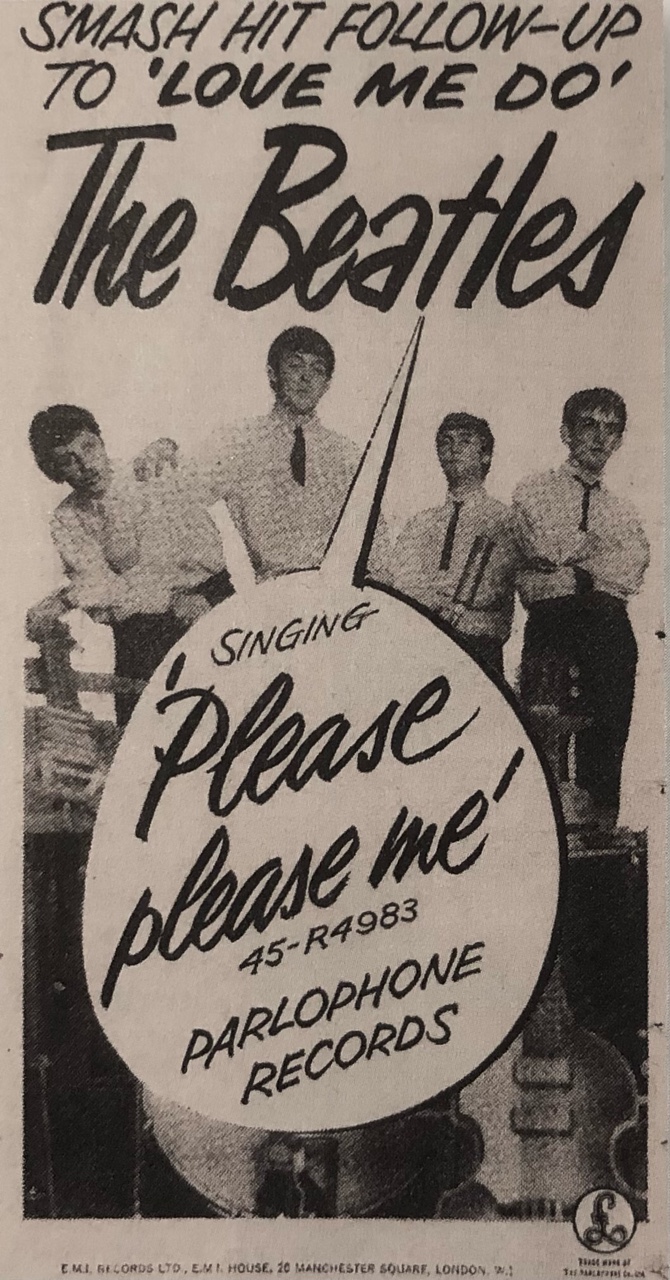
A second single was released on 11 January 1963, Please Please Me/Ask Me Why (Parlophone 45-R 4983). Chart success depends on which 'hit parade' you choose to follow as each pop newspaper had its own. Melody Maker, Disc and New Musical Express all placed Please Please Me at #1 while it only registered at #2 on Record Retailer's listing.


Ask Me Why had been attempted at the 6 June session while Please Please Me was first recorded on 11 September towards the end of the session. Written in a style more akin to Roy Orbison, it was considered 'dreary' by George Martin who suggested it would work better in a faster tempo with tighter harmonies and wanted them to go away, work on the song and bring it back for the next session. Unfortunately none of the earlier versions exist as the tapes were erased/destroyed... fortunately in future this would not be the case and most, if not all, of the The Beatles session tapes were kept.

They returned to Please Please Me and Ask Me Why at a session held on 26 November 1962. The session saw the return of Ringo Starr and the talk of using a session musician was never raised again. Satisfactory masters were taped with Martin telling them, "You've just made your first number one." He was proved right.


All four tracks from their first two singles were written by John Lennon and Paul McCartney and would be included on their debut album. A minor dispute between the two composers meant these early singles and their debut album saw all their songs credited to McCartney/Lennon, although this would change in late-1963 and the classic song-writing credit of Lennon/McCartney would appear on all future songs written by them.

Following on from the success of both singles, George Martin wanted them to record an album. His first idea was a live album to be recorded at The Cavern in Liverpool but having visited the venue and realising the acoustics were unsuitable the idea was dropped.

They already had four songs so plans were made to record a further ten tracks to complete the album. Martin recalled, "I asked them what they had which we could record quickly, and the answer was their stage act."

Morning and afternoon sessions were booked at the EMI Studios in St. John's Wood (later renamed Abbey Road Studios) where the previous sessions had taken place. The date was set for 11 February during a break in their first national tour.

George Martin produced the session with Norman Smith and Richard Langham sharing the role of engineer.

Photo (c) Unknown

At the morning session, 10am to 1pm, they recorded two tracks, There's A Place and Seventeen (working title of I Saw Her Standing There). Both tracks were written by McCartney/Lennon. The group worked through the break and at the second session, 2.30pm to 6pm, finished masters of A Taste Of Honey, Do You Want To Know A Secret and Misery were completed. Further attempts at There's A Place and Seventeen (I Saw Her Standing There) were also completed. With the exception of A Taste Of Honey, which was written by Bobby Scott and Ric Marlow and featured in the film of the same name in 1961, all the songs recorded during the second session were McCartney/Lennon compositions.

An evening session had been added during which the remaining five songs, all cover versions, needed for the album were recorded. First up was Anna (Go To Him) written by Arthur Alexander and a minor hit for him in 1962. Recorded in just one take and featuring a lead vocal by Ringo Starr was a cover of The Shirelles Boys followed by the Gerry Goffin and Carole King composition Chains, a hit for the girl group The Cookies. Another Shirelles hit, Baby It's You, written by Burt Bacharach, Mark David and Barney Williams was the penultimate song recorded on this day.

With time moving by fast and the studio gearing up to close down for the night they needed one more song. Discussing various options over a coffee in the canteen it was decided to wind up the days work with the old Isley Brothers hit Twist And Shout, written by Phil Medley and Bert Russell. John Lennon had been suffering from a cold and sore throat throughout the session but sang a blistering version of the song which must have almost shredded his vocal chords. Often wrongly credited as being recorded in one take there were actually two takes recorded. However, Lennon couldn't better his first attempt. After the session George Martin was quoted as saying, "I don't know how they do it. We've been recording all day but the longer we go on the better they get." Lennon later remarked, "The last song nearly killed me!."

They also recorded Hold Me Tight, the first number and only McCartney/Lennon song recorded during the third session, which was surplus to requirements, ended up unreleased and would suffer the same fate as the early takes from their first two singles... erased or destroyed. They would return to the song for their second album, With The Beatles, released in November 1963.

As Mark Lewisohn wrote, "There can scarcely have been 585 more productive minutes in the history of recorded music. For in that small space of time, The Beatles recorded all ten new songs for their first long-player."

On 11 January George Martin added piano to the song Misery and a few days later mono and stereo masters of the album were produced by Martin. The Beatles weren't present for either of these sessions.


Please Please Me was released in the UK on 22 March 1963 and, as was normal record company practice at the time, was issued in mono only. It would be a month before a stereo version was released. Back in the 1950s and early-1960s 45rpm singles were the most popular format for pop music and long playing albums were often reserved for other musical genres like classical and jazz. 

The albums title, despite being an obvious choice considering the success of the single, was not George Martin's first choice. He originally suggested giving the album the title Off The Beatle Track but good sense prevailed. However, his suggestion would find a use as it became the title of his own album of orchestral versions of Beatles songs. As an honorary fellow of the Zoological Society of London he also had the idea of photographing the group outside the insect house for the albums cover, the request was declined.

The image used on the cover was taken by theatrical photographer Angus McBean on the stairwell at the Manchester Square offices of EMI Records. The photograph was taken in December 1962 and was one of several taken that day. Wearing burgundy suits, pink shirts and black ties various poses were captured. Three of the shots were used on future releases, the most important being the cover of Please Please Me. Six years later he would create the same images for use on the ill-fated Get Back album. It was never used and a different photo appeared on Let It Be. However, the photo was eventually used along with the 1962 shot on the greatest hits packages, The Beatles 1962-66 and 1967-70.

Angus McBean's stairwell photo wasn't the first choice though. Dezo Hoffman was present at the 11 February session and captured several images of the group. As a cover image was required he captured the group posing 'chorus line' style on the steps of the studio. As Hoffman stated, the photo did not work although he would have many more published over the next few months.

Photo (c) Dezo Hoffman

Liner notes were written by publicist Tony Barrow. and in part read... 'The Beatles had been voted Merseyside's favourite outfit and it was inevitable that their first Parlophone record, Love Me Do, would go straight into the top of Liverpool's local hit parade. The group's chances of national chart entry seemed much more remote. No other team had joined the best-sellers via a debut disc. But The Beatles were history-makers from the start and Love Me Do sold enough copies during it's first 48 hours in the shops to send it soaring into the national charts. In all the busy years since pop singles first shrank from ten to seven inches I have never seen a British group leap to the forefront of the scene with such speed and energy.'

Reviews were good with Norman Jopling, writing in the 30 March 1963 issue of Record Mirror, that for a debut LP the album is "surprisingly good and up to standard." He went on to say the album contained many tracks that could have been released as singles, such as I Saw Her Standing There and Misery. He also praised the packaging, writing that the cover image and sleeve notes provided extra value.

Author Jonathan Gould would echo Jopling's comments about the packaging stating that the albums packaging contributed to its success, promising fans 'glossy cover art' and a greater companion to the music than the plain paper packaging then offered by singles.

In a 5 April 1963 review headed 'Please Please Me - 14 Thrillers', Allen Evans wrote, "Fourteen exciting tracks, with the vocal-instrument drive that has put this Liverpool group way up on top in a very short time. The title tune and Love Me Do are well known, but there are twelve other thrillers, including John Lennon's singing of a torrid Twist And Shout, and The Shirelles Baby It's You, Boys, with drummer Ringo Starr shining; and a pippin of a duet of Misery by John and Paul ; and lead guitarist George Harrison is powerfully evident throughout."

The album reached the top of the UK album charts in May 1963 where it stayed for 30 weeks before being knocked off the summit by the groups second album With The Beatles. An incredible achievement when you consider the charts were dominated by soundtracks and easy-listening vocalists at the time.

In America, where EMI's subsidiary Capitol Records had been offered the chance to release Beatles material but turned it down, it was the small Vee-Jay Records who took up the opportunity to bring The Beatles to an American audience.

They released the single Please Please Me/Ask Me Why (Vee-Jay VJ 498) in February 1963 but it failed to chart. They originally planned to release the Please Please Me album as per the UK release with fourteen tracks but ended up trimming it down to the standard twelve track album, as popular in America at the time, and left off the two tracks that had been issued as a single. It was also given a new title, Introducing The Beatles (Vee-Jay VJLP 1062) and was released in July 1963.


Capitol soon realised they had missed out and with Vee-Jay losing interest future Beatles material would be issued on the Capitol Records label.

Some songs from the album also made it onto three extended play releases. A popular format in the 1950s and 1960s, these offered four or five tracks in a laminated sleeve looking a lot like miniature albums. They were often seen as a showcase for the best tracks from an album although some artists, not The Beatles, released all the tracks from their current album on three or four separate extended play releases. Priced midway between the cost of a single and an album they offered good value.

The first three Beatles extended play releases on Parlophone all featured material from the album.

Released on 12 July 1963 Twist And Shout (Parlophone GEP 8882) bought together four album tracks, Twist And Shout, A Taste Of Honey, Do You Want To Know A Secret and There's A Place. The cover photo, taken and designed by Dezo Hoffman, showed the four members of the group jumping off a wall.

The Beatle's Hits (Parlophone GEP 8880), released in September 1963, featured both Please Please Me and Love Me Do on side two and two other hits, From Me To You and Thank You Girl on side one, neither of which were taken from the album. The cover showed the group against a white background and was taken by Angus McBean in his studio.

The third expended play to feature material from the album was released in November 1963. The Beatles No. 1 (Parlophone GEP 8883) opened with I Saw Her Standing There and also included Misery, Anna (Go To Him) and Chains. The cover was an alternate shot from the Angus McBean album cover photo session at Manchester Square.


All three hit the top spot on the UK EP Chart and also managed to enter the UK Singles Chart with Twist And Shout reaching #4 and selling over 800,000 copies, The Beatles Hits peaked at #17 and The Beatles No. 1 stalled just outside the top twenty at #24.

In the UK Please Please Me was released in numerous incarnations giving collectors a wide choice, and headache, when collecting the various versions... mono, stereo, re-issues etc. To give details of all the various releases is way beyond the scope of this article and I would point anyone interested in finding out more to the many books and magazines that are available.

While the album may never be a candidate for the deluxe treatment given to other albums like Revolver, The White Album, Abbey Road and Sgt. Pepper's Lonely Hearts Club Band I do feel Please Please Me is worthy of a deluxe release. I hope one day that a release featuring both the mono and stereo versions of the album with outtakes, of which there are enough for a couple of discs, along with a booklet of comprehensive liner notes, photos and memorabilia can be considered.

Please Please Me is in my top three favourite Beatles albums and one I return to often. I think the sequencing of the tracks was perfect and whenever I play the album I realise those opening couple of lines are some of my favourite opening lyrics of any album in my collection - 

03 March 2023

THE WHO

Formed in 1964 in London the The Who consisted of Roger Daltrey (lead vocalist), Pete Townshend (guitar), John Entwistle (bass) and Keith Moon (drums).


One of the most influential bands of the 20th century they introduced many styles including using large PA systems and guitar techniques. They were part of the mod movement and the first to develop the idea of the rock opera.

Their first single was I Can’t Explain, released in 1965, and a top ten in the United Kingdom. They followed with a string of hits during the 1960s including My Generation (1965), Substitute (1966), Happy Jack (1966), Pictures of Lily (1966), I Can See For Miles (1967), Magic Bus (1968), Pinball Wizard (1969) and I’m Free (1969).

More hits followed in the 1970s and 1980s with Won’t Get Fooled Again (1970), 5.15 (1973), Squeeze Box (1975) and You Better You Bet (1981).

Success in the UK didn’t follow in the USA where I Can See For Miles was the bands only top-ten single.

Surprisingly they never achieved a number one in the UK, and their best chart position was with My Generation and I'm A Boy, both of which reached number two in 1965 and 1966.

Released in 1965, My Generation was the bands first album. Reaching number five in the UK, it failed to chart in the USA where it was issued with the title The Who Sings My Generation. More albums followed, A Quick One (1967), The Who Sell Out (1967), Who’s Next (1971) their only number one album, The Who By Numbers (1975) and Who Are You (1978).

Critical and commercial success came their way with the two concept albums released in 1969 and 1973 with Tommy and Quadrophenia, both reaching number two in the UK and number four and two respectively in the USA. Both albums were adapted into successful movies.

Released in 1975, Tommy is a satirical, fantasy, drama film written and produced by Ken Russell. Based on the rock opera album it told the story of a deaf, dumb and blind kid who becomes a pinball champion. The film featured the band members along with Oliver Reed, Ann Margret, Eric Clapton, Elton John and Jack Nicholson. Awards came Ann Margret's way when she received a Golden Globe for her performance. She was also nominated for Best Actress at the Academy Awards. Pete Townshend received an Oscar nomination for adapting the music for the film. The film won Rock Movie Of The Year at the First Annual Rock Music Awards in 1975.

Directed by Franc Roddam and released in 1979, Quadrophenia, differed from Tommy in that it wasn't a musical and none of the band appeared in the film. Starring Phil Daniels, Leslie Ash, Sting, Toyah Wilcox and Mark Wingett it was set in London in 1964, when youths were either mods or rockers. The Mods dressed in sharp suits, rode scooters and were into current pop music while the Rockers rode powerful Triumph and BSA motorcycles, wore black leather and listened to rock 'n' roll. The two factions end up in a violent brawl in Brighton. 

The Who were also a major draw on the concert circuit. In 1967 they played the Monterey Pop Festival and other festival appearances included Woodstock and The Isle of Wight. Several live albums were issued starting in 1970 with Live At Leeds, a number three UK hit, followed by Who’s Last (1984), Join Together (1990), Blues In The Bush (2000) and View From A Backstage Pass (2007).

Some of their earlier concerts were also issued on record with appearances at the Isle Of Wight Festival in both 1970 and 1984 along with a 1970 concert recorded in Hull. Some of the bands BBC Sessions also found a release as did a live performance of Quadrophenia, recorded live in London.

In 1978 drummer Keith Moon tragically died and his place in the band was taken by Kenney Jones. With Townsend’s departure the band split in 1983 although they would reform for occasional appearances including Live Aid in 1985 and a 25th Anniversary Tour. A full reunion in 1999 found Zak Starkey, son of Beatles drummer Ringo, replace Kenney Jones on drums. Former band member John Entwistle died in 2002 delaying plans for their new album.

The Who continued to tour with a new line up of Roger Daltrey, Zak Starkey, Pino Palladino on bass and Simon Townsend, Pete’s brother, on guitar.

The Who live on stage is where a new book fits into our story. The Who - Concert Memories from the Classic Years 1964 to 1976 is written/compiled by Edoardo Genzolini and published by Schiffer Publishing.

The books format traces the concerts given by The Who during the years 1964 through to 1976 with interviews with and stories from fans who attended the shows along with hundreds of previously unpublished photos from the time. However, it is not only the fans memories as there are stories from promoters, roadies, film-makers, journalists and photographers.

Hundreds of concerts are covered including those in London (1965), Monterey Pop Festival, California (1967), Sydney (1968), Winterland, San Fransisco (1968), Marquee Club, London (1968), Woodstock (1969), New York (1971), Zurich (1972) and many more.

Most of the photos, a mix of colour and black & white, are amateur and in some cases blurry or dark but this just adds to the charm and appeal of the book. 

It is not only the live photos that are interesting. There are many back-stage photos and the occasional tape box or cassette image showing concerts recorded professionally or illegally by fans.

The anecdotes from fans about the concerts they attended are the main part of the book but there are also events from the bands career covered including their early beginnings, the recordings, the impact that both Tommy and Quadrophenia had on the public and what is considered by fans and critics alike to be their greatest album, Who's Next.

Author Edoardo Genzolini has amassed an incredible amount of details from all over the world and his dedication and enthusiasm shows in every page.

In an email to the books editor and contributor Jerry Goodwin, Pete Townshend wrote, "Edoardo's book looks wonderful. The photos are very special. His take on The Who, and on me, is intriguing and extremely insightful. I wasn't always a pleasant person to be around in the early days. It's good to see that sometimes I managed to do some decent things for fans."

This coffee-table book, about which Pete Townshend described as, "extremely insightful", is beautifully produced and printed on high-quality gloss paper which shows of the photos at their best.

Reading the text and looking at the photos makes you wish that you had been in the audience at one of these gigs... or maybe you were. The book will be well received by fans of the group and anyone interested in 1960s/1970s rock music.

With thanks to Victoria Hansen at Schiffer Publishing Ltd for providing a review copy of the book.