Showing posts with label Beatles. Show all posts

27 November 2025

EVERYTHING AND THE KITCHEN SINK

I love the films from the 1950s and 1960s and this new book, Everything And The Kitchen Sink - UK Film, Music and TV Before The Beatles, written by Simon Matthews, looks in detail at a period whose movies, and TV programmes, have been classed as 'Kitchen Sink Drama'.

The term 'Kitchen Sink Drama' comes from a British cultural movement from the 1950s/1960s that used social realism to depict the gritty and everyday lives of working-class people. It focussed on many themes including social inequality, poverty, pregnancy, abortion, domestic struggles and created the disillusioned, rebellious working-class heroes who, frustrated with the hand they had been dealt in life, became 'Angry Young Men.'

The term originated from a 1954 article by an art critic on young painters who concentrated on mundane domestic scenes. The movement began in British theatre but soon spread to film and TV. 


Over seven main chapters Matthews gives the reader a detailed look at the many films released during the 1950s and 1960s including such classics as A Taste Of Honey, Saturday Night And Sunday Morning, Room At The Top, The Leather BoysLook Back In Anger, Billy Liar and A Kind Of Loving.

There are details about how many of the films started life as books and stage plays, including where the plays were first performed. Problems finding distributors and the different actors who were considered for the lead and supporting roles are covered in comprehensive detail and make for fascinating reading.

The list of people mentioned in the book reads like a who's who with authors and playwrights (John Osborne, Alan Sillitoe, Shelagh Delaney), actors (Albert Finney, Alan Bates, Rita Tushingham, Leonard Rossiter) and producers and directors (Michael Winner, Richard Lester and Ken Loach) all featured.

There are too many other movies to list here but A Place To Go, The L-Shaped Room, Idol On Parade, The Loneliness Of The Long-Distance Runner, Lucky Jim and Only Two Can Play are just a few that are covered in similar detail to the rest.

Both Tony Hancock and Peter Sellers  work on TV, radio and films is covered with a look at Hancock's Half Hour, The Rebel, The Goon Show, Carlton Browne Of The F. O. and I'm Alright Jack among others.


During the late-1950s and throughout the 1960s there were many 'pop' musicals that featured the top artists/groups of the time. Most were simply vehicles to bring together a selection of current hits wrapped up in flimsy plots. However, they were very popular at the time and I have fond memories of many of them.

The book looks at a few of these... It's Trad Dad! (Helen Shapiro), Play It Cool (Billy Fury), What A Crazy World (Joe Brown), Serious Charge (Cliff Richard) and Expresso Bongo (Cliff Richard), the two Cliff Richard movies having a more serious storyline than many of the others. This all leads to The Beatles and A Hard Days Night.

A number of TV productions are also included, many of which I remember watching as a youngster... Z-Cars (one of my favourites), Dixon Of Dock Green, Danger Man, Coronation Street, The Avengers and Steptoe & Son.

As well as the 'Pop' musicals discussed earlier, a number of music programmes also get a mention... Oh Boy!Six-Five Special, Ready Steady Go and Top Of The Pops.


One of my favourite movies from this period is Beat Girl, set in the Soho scene and starring Adam Faith, Gillian Hills, Noelle Adam and Christopher Lee with music by Adam Faith and The John Barry Seven and I was pleased to see it covered.

The book includes a foreword by Sir Tom Courtenay, a detailed list of commercially released music related to the films, theatre and TV productions mentioned in the book with details of singles, extended play releases and long playing albums and a comprehensive index to the books content.

There are so many great stories throughout the book and I'll leave it to the reader to find out more. However, I do want to mention one that I found very interesting, regarding The Beatles and their first film role. I have added additional information to that covered in the book.

In 1964 A Hard Days Night was released and became an instant and major success, as did the accompanying soundtrack album and singles that were released.

However it could all have been so different. The Beatles were first offered a chance to appear in the 1963 film The Yellow Teddybears, a slice-of-life drama whose plot was described as... 'A clique of girls in an English school who wore small yellow teddy bears on their uniforms to signify that they were no longer virgins!' The leader of the girls, Linda, fears she might be pregnant by her boyfriend, with the name 'Kinky', a wannabe singer.


The movie, directed by Robert Hartford-Davis with a script by Donald Ford and Derek Ford, had a cast that included Jacqueline Ellis, Georgina Patterson, Annette Whiteley, Jill Adams and Iain Gregory.

In the movie The Beatles would be required to sing six songs, none of which would be written by them. It was also going to be released with an alternate, and less-appealing, title... Gutter Girls!

Manager Brian Epstein, and no doubt the band themselves, turned the offer down. Paul McCartney, in later interviews said, "We were excited but it turned out that the fella involved was going to write all the songs, and we couldn't have that." John Lennon also had a few words of his own, "We didn't even want to make a movie that was going to be bad, and we insisted on having a real writer to write it." Fortunately Alun Owen wrote a screenplay that did appeal to the band... A Hard Days Night and the rest, as they say, is history.

Taking a slight detour I wanted to mention a Hidden London Tour I went on a few years ago... Euston Underground - The Lost Tunnels. What has this to do with the book I hear you say. Well, the tour included walks along old running tunnels, passenger walkways and old lift shafts, all of which hadn't been accessed by passengers for many years.


One tunnel was a fascinating trip into the past with the walls covered in adverts and original movie posters from the 1950s and 1960s. One poster was for 1962's A Kind Of Loving and is shown above. There were many others advertising titles like West Side Story, Psycho and The Terror Of The Tongs, although none of these fall into the 'Kitchen Sink Drama' category. 

I really enjoyed this book and it bought back so many memories and has prompted me to add many of the films mentioned in the book to my Blu-Ray collection. I also learnt so much more about the films, directors, authors, artists, screenwriters and fascinating background to the making of the films, especially locations used.

If I had one minor complaint, and it takes nothing away from the text in the book, is the lack of illustrative material. Yes, there are a handful of great black & white, period photos but a book like this would have benefitted from more images including original posters, lobby cards, advertising material, cinema ads and publicity photos. I have included a collage of several of these above to help illustrate my review/article.

Despite the above comment, this book gets five-stars from me and is highly recommended... I'm now off to watch A Kind OF Loving.


05 September 2023

COLLECTING MUSIC & FILM MEMORABILIA

My love of music dates back to the early-seventies and over the fifty years that followed my music collection has gone from vinyl and cassettes to Compact Discs and, despite not being a great fan of the medium, digital downloads.

Anyone that knows me will know that I have a wide taste in music and listen to everything from rock 'n' roll to blues, country, Americana, country rock, pop and even jazz and orchestral. To be honest the only styles I am not interested in are rap and opera.

Just a few of my favourite artists are Elvis Presley, Johnny Cash, Linda Ronstadt, Emmylou Harris, Gram Parsons, Fleetwood Mac, The Beatles and The Beach Boys, although this is only a small section of my music tastes.

I also enjoy films although my tastes are the films from the 40s, 50s, 60s and 70s rather than the big blockbusters from the past few decades. However, there are still some favourites from the later years with Die Hard being top of my list. My favourite male and female movie stars all date back to the great days of Hollywood... James Stewart and Gene Tierney. You can read more about Gene Tierney here on my blog in the article Gene Tierney - Hollywood Beauty.

Although not an avid collector who has to have everything, I do collect items of music and film memorabilia including promo CDs, press photos, sheet music, lobby cards and press books. A few items from my collection are pictured below.


This brings me to books on collecting music and film memorabilia of which I have several in my library including The Lyle Price Guide - Film & Rock 'n' Roll Collectables by Tony Curtis,  The Elvis Collector - An Introductory Guide To Collecting UK Film Memorabilia 1956-1977 and The Elvis Collector - An Introductory Guide To Collecting UK Memorabilia 1956-1977 the latter two compiled and written by Harry Carrigan.

I recently received three books from Schiffer Publishing which cover Elvis Presley, The Beatles and Sheet Music from the 1960s, all three of which are reviewed below.

Elvis Presley Memorabilia - An Unauthorized Collectors Guide (Sean O'Neil) (Schiffer Publishing 2001 - ISBN 0-7643-1382-7) 


Following a brief introduction which covers prices and counterfeit items the 160-page book is split into seven chapters which cover Elvis' career - Elvis In Concert, Elvis Presley Enterprises and Novelty Items, Sun Records and RCA Victor Records, Magazines, The Movies, One-of-a-Kind and Autographs, Photos and Other Paper. Each chapter opens with a short introduction.

The Concert section features early press ads, photo albums that were sold at the concerts, ticket stubs and much more. Moving into the seventies there are more ads and souvenir photo albums, a few which I still have in my own collection.

The items produced by Elvis Enterprises ranges from the sublime to the ridiculous with record cases, photo cards and record players to jewellery and even  'I Like Elvis' and 'I Hate Elvis' badges, the Colonel certainly catered for both camps.

The Records section was of special interest to me as I love the old RCA ads and various sheet music featured.

Of the remaining sections there are various magazines from the 1950s through to the 1970s, movie posters, lobby cards and advertising, rare items that don't fit in any other part of the book, so are given their own chapter and finally some festive items. Christmas was a special time for Elvis and every year the Colonel produced a postcard, some classy and others less so... Elvis in a jumpsuit by a Christmas tree!

The book is beautifully produced, with mostly colour illustrations and includes a brief description of each item along with the then current values.


The Beatles Yesterday & Tomorrow - A Collector's Guide To Beatles Memorabilia (Courtney McWilliams) (Schiffer Publishing 1999 - ISBN 0-7643-0852-1) 


A preface explaining condition of memorabilia and an introduction that covers the early days of the group in Liverpool and Hamburg is followed by nine chapters covering various areas of collecting. Over 210-pages  the book covers - Vintage Beatles, All Movie Memorabilia, Fan Club Memorabilia, Jewellery, The Beatles As Art, Music Mediums, Ephemera, Solo Efforts and Something New.

Following the same format as the Elvis book this is a treasure trove of Beatles memorabilia, beautifully illustrated with an introduction to each chapter and every item has a brief description and guide to value.

I really enjoyed the sections on the movies with all the posters, lobby cards, press ads and stills. The records section includes the well known UK releases but also the albums released on Capitol in America, Beatles '65, The Early Beatles and Beatles VI. The infamous 'Butcher Cover' which was originally planned to be the cover of the Capitol album The Beatles Yesterday and Today is also included. One of the rarest Beatles items that nowadays is almost impossible to find and is worth at least the $6,000 - $12,000 value quoted for a copy in mint condition.

Like Elvis Presley there are items that fall into the same category... from the sublime to the ridiculous. Beatles wigs, masks, lunch boxes, thermos flasks and, depending who your favourite band members was, badges with 'I Love Paul', 'I Love John', 'I Love George' and 'I Love Ringo'. I couldn't see any 'I Hate The Beatles' badges and maybe none were ever produced.

A chapter on their solo work seems to devote more pages to John Lennon than Paul, George or Ringo which is had to understand when you look at the amount of solo work released by the other three ex-Beatles.

The final chapter, Something New, covers some of the more recent items available and those issued after the break-up in the 1970s.


Collecting Rock 'n' Roll Sheet Music Of The 1960s  (Valerie Carallo) (Schiffer Publishing 2006 - ISBN 0-7643-2373-3) 


Split over 176-pages this book includes an introduction which explains what sheet music is, the differences between USA, UK and Australian sheet music and value and condition. The book then covers seven different genres of music - Twist and Shout (The Beatles), Wipe Out (Surf and Folk), Psychotic Reaction (Garage, Hard Rock and Psychedelia), Lightnin' Strikes (Pop and Rock), Going To A Go-Go (R&B, Soul and Motown), Catch Us If You Can (The British Invasion) and Thank U Very Much (Bubblegum, Girl Groups, Novelty Songs etc).

I particularly enjoyed the chapter on The Beatles with many great cover images and designs including those for Ask Me Why, A Day In The Life, Till There Was You, Girl and Back In The U.S.S.R. A few foreign items are displayed... Tu Mano Cogere (I Want To Hold Your Hand) from Spain, Elle (Il) T'Auime (She Loves You) from France and the German issue of Twist im Blut (Twist And Shout).

Many of my favourite artists are covered in the book with The Beach Boys featured heavily with Sloop John B, Dance Dance Dance, The Man With All The Toys, God Only Knows and my personal favourite sheet music cover from the group, Surfer Girl.

With over 600 illustrations there are too many to cover in this review. However, besides those already mentioned these are just a few of my personal favourites... Rainy Day Women #12 & 35 (Bob Dylan), Mrs Robinson (Simon & Garfunkel), I'm A Boy (The Who), These Boots Are Made For Walking (Nancy Sinatra), Alternate Title (The Monkees), A Boy Named Sue (Johnny Cash) and Ode To Billy Joe (Bobbie Gentry). The latter has the title misspelled as the title is actually Ode To Billie Joe.

Being a big fan of Linda Ronstadt I couldn't end this review without mentioning the inclusion of Different Drum by The Stone Poneys which features the lovely Linda on the cover.

Many of those, me included, who collect sheet music are not buying them because they can read music but because of the images featured on the covers many of which were rare and differed from the image featured on the 45rpm single. 

Like the Elvis and Beatles books this one is beautifully produced, illustrated in full colour and printed on high quality, glossy paper. Each chapter has a brief introduction and, like the previous books, includes a description of each item featured along with a guide to the value.

I really enjoyed going through these books and seeing the amount of items that were produced with the names Elvis Presley and The Beatles, some tacky and some very collectable. I wonder how many of the items have survived in their original packaging and in mint condition. Likewise, the sheet music book, was a fascinating insight into what is still a very collectable market.

Although all three books were originally published between 1998 and 2006 they can still be found on various sites on the internet and if you are like me and find this kind of information fascinating then I recommend checking them out.

With thanks to Victoria Hansen at Schiffer Publishing Ltd for providing copies of the books for this article.

22 March 2023

PLEASE PLEASE ME

On 22 March 1963 The Beatles released their debut album Please Please Me and to celebrate the sixtieth anniversary we look back at the recording, release and reception of this classic album.

Photo (c) Unknown

The Beatles had audition for Decca Records in January 1962 but were turned down. Their loss was EMI Records gain as, in May, they signed a contract with EMI who offered them a contract with their Parlophone label. The label was run by George Martin who had previous success with comedy records by artists including Peter Sellers, Spike Milligan and Bernard Cribbins. Martin would become known as the 'fifth' Beatle due to his involvement in the groups recorded output. At his first session with them on 6 June 1962 he was, at first, unimpressed with their songs and playing. In the control room he asked them individually if there was anything they didn't like... George Harrison replied, "I don't like your tie." This broke the ice and set up a working relationship that would produce a series of classic albums and hit singles, the like of which had never been seen before.

The Beatles released their first single, Love Me Do/P.S. I Love You (Parlophone 45R-4949), on 5 October 1962 and it reached a respectable #17 in the UK. Three versions of Love Me Do had been recorded during sessions on 6 June, 4 September and 11 September with three different drummers playing on the track. Pete Best played on the first recording but was dismissed from the group soon after. On the recordings made a few weeks later it was Ringo Starr who was behind the drum kit, although Paul McCartney wasn't happy with his drumming, feeling it could be better. For the third attempt session drummer Andy White played the drums while Ringo Starr had to settle for playing the tambourine.

Photo (c) Dezo Hoffman

P.S. I Love You had been attempted at the first session in June but it was the version recorded on 11 September that became the B-Side to their first single. Once again Ringo had to step aside and only played maracas.

Interestingly two versions of Love Me Do were issued. Early copies of the single featured Ringo Starr but from 1963 all future copies of the song featured Andy White, including the version that would appear on their debut album. To avoid any future issues the tape featuring Ringo was apparently destroyed. You can tell which version you are listening to as the one without the tambourine features Ringo on drums and is from the 4 September session while the one with the tambourine features Andy White and dates from 11 September.


The first recording, featuring Pete Best on drums, finally found a release on Anthology I, released in 1995 and one of three 2-CD sets released to coincide with the The Beatles Anthology TV series.

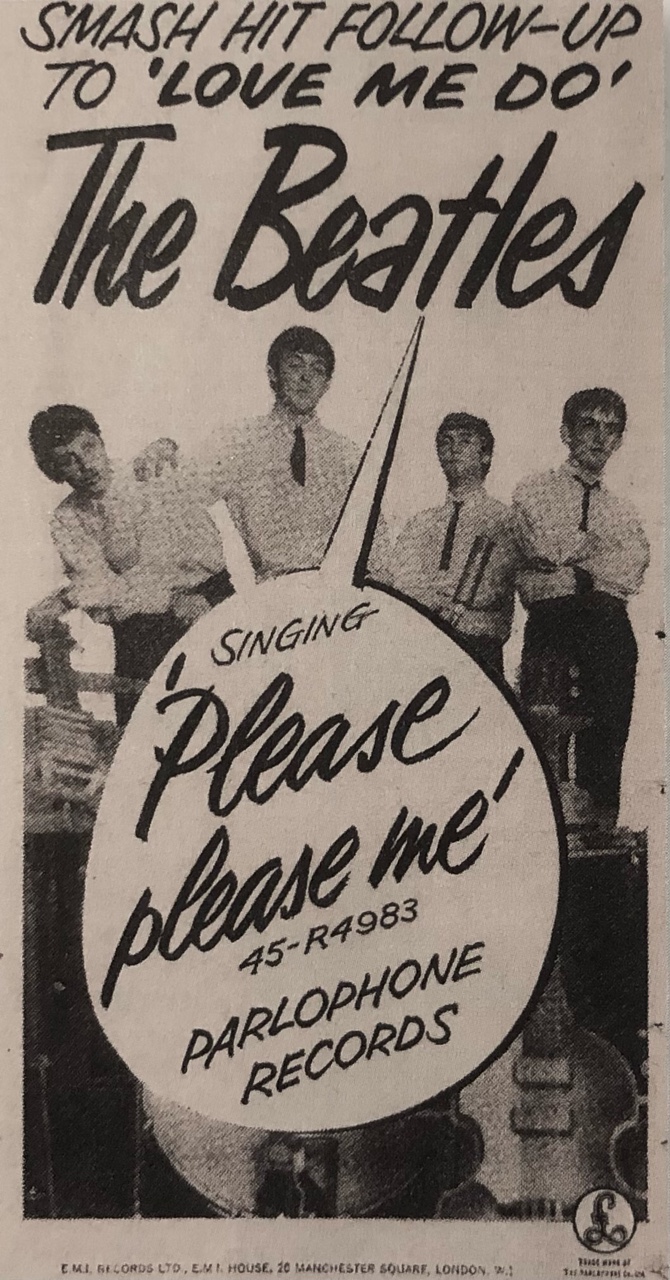
A second single was released on 11 January 1963, Please Please Me/Ask Me Why (Parlophone 45-R 4983). Chart success depends on which 'hit parade' you choose to follow as each pop newspaper had its own. Melody Maker, Disc and New Musical Express all placed Please Please Me at #1 while it only registered at #2 on Record Retailer's listing.


Ask Me Why had been attempted at the 6 June session while Please Please Me was first recorded on 11 September towards the end of the session. Written in a style more akin to Roy Orbison, it was considered 'dreary' by George Martin who suggested it would work better in a faster tempo with tighter harmonies and wanted them to go away, work on the song and bring it back for the next session. Unfortunately none of the earlier versions exist as the tapes were erased/destroyed... fortunately in future this would not be the case and most, if not all, of the The Beatles session tapes were kept.

They returned to Please Please Me and Ask Me Why at a session held on 26 November 1962. The session saw the return of Ringo Starr and the talk of using a session musician was never raised again. Satisfactory masters were taped with Martin telling them, "You've just made your first number one." He was proved right.


All four tracks from their first two singles were written by John Lennon and Paul McCartney and would be included on their debut album. A minor dispute between the two composers meant these early singles and their debut album saw all their songs credited to McCartney/Lennon, although this would change in late-1963 and the classic song-writing credit of Lennon/McCartney would appear on all future songs written by them.

Following on from the success of both singles, George Martin wanted them to record an album. His first idea was a live album to be recorded at The Cavern in Liverpool but having visited the venue and realising the acoustics were unsuitable the idea was dropped.

They already had four songs so plans were made to record a further ten tracks to complete the album. Martin recalled, "I asked them what they had which we could record quickly, and the answer was their stage act."

Morning and afternoon sessions were booked at the EMI Studios in St. John's Wood (later renamed Abbey Road Studios) where the previous sessions had taken place. The date was set for 11 February during a break in their first national tour.

George Martin produced the session with Norman Smith and Richard Langham sharing the role of engineer.

Photo (c) Unknown

At the morning session, 10am to 1pm, they recorded two tracks, There's A Place and Seventeen (working title of I Saw Her Standing There). Both tracks were written by McCartney/Lennon. The group worked through the break and at the second session, 2.30pm to 6pm, finished masters of A Taste Of Honey, Do You Want To Know A Secret and Misery were completed. Further attempts at There's A Place and Seventeen (I Saw Her Standing There) were also completed. With the exception of A Taste Of Honey, which was written by Bobby Scott and Ric Marlow and featured in the film of the same name in 1961, all the songs recorded during the second session were McCartney/Lennon compositions.

An evening session had been added during which the remaining five songs, all cover versions, needed for the album were recorded. First up was Anna (Go To Him) written by Arthur Alexander and a minor hit for him in 1962. Recorded in just one take and featuring a lead vocal by Ringo Starr was a cover of The Shirelles Boys followed by the Gerry Goffin and Carole King composition Chains, a hit for the girl group The Cookies. Another Shirelles hit, Baby It's You, written by Burt Bacharach, Mark David and Barney Williams was the penultimate song recorded on this day.

With time moving by fast and the studio gearing up to close down for the night they needed one more song. Discussing various options over a coffee in the canteen it was decided to wind up the days work with the old Isley Brothers hit Twist And Shout, written by Phil Medley and Bert Russell. John Lennon had been suffering from a cold and sore throat throughout the session but sang a blistering version of the song which must have almost shredded his vocal chords. Often wrongly credited as being recorded in one take there were actually two takes recorded. However, Lennon couldn't better his first attempt. After the session George Martin was quoted as saying, "I don't know how they do it. We've been recording all day but the longer we go on the better they get." Lennon later remarked, "The last song nearly killed me!."

They also recorded Hold Me Tight, the first number and only McCartney/Lennon song recorded during the third session, which was surplus to requirements, ended up unreleased and would suffer the same fate as the early takes from their first two singles... erased or destroyed. They would return to the song for their second album, With The Beatles, released in November 1963.

As Mark Lewisohn wrote, "There can scarcely have been 585 more productive minutes in the history of recorded music. For in that small space of time, The Beatles recorded all ten new songs for their first long-player."

On 11 January George Martin added piano to the song Misery and a few days later mono and stereo masters of the album were produced by Martin. The Beatles weren't present for either of these sessions.


Please Please Me was released in the UK on 22 March 1963 and, as was normal record company practice at the time, was issued in mono only. It would be a month before a stereo version was released. Back in the 1950s and early-1960s 45rpm singles were the most popular format for pop music and long playing albums were often reserved for other musical genres like classical and jazz. 

The albums title, despite being an obvious choice considering the success of the single, was not George Martin's first choice. He originally suggested giving the album the title Off The Beatle Track but good sense prevailed. However, his suggestion would find a use as it became the title of his own album of orchestral versions of Beatles songs. As an honorary fellow of the Zoological Society of London he also had the idea of photographing the group outside the insect house for the albums cover, the request was declined.

The image used on the cover was taken by theatrical photographer Angus McBean on the stairwell at the Manchester Square offices of EMI Records. The photograph was taken in December 1962 and was one of several taken that day. Wearing burgundy suits, pink shirts and black ties various poses were captured. Three of the shots were used on future releases, the most important being the cover of Please Please Me. Six years later he would create the same images for use on the ill-fated Get Back album. It was never used and a different photo appeared on Let It Be. However, the photo was eventually used along with the 1962 shot on the greatest hits packages, The Beatles 1962-66 and 1967-70.

Angus McBean's stairwell photo wasn't the first choice though. Dezo Hoffman was present at the 11 February session and captured several images of the group. As a cover image was required he captured the group posing 'chorus line' style on the steps of the studio. As Hoffman stated, the photo did not work although he would have many more published over the next few months.

Photo (c) Dezo Hoffman

Liner notes were written by publicist Tony Barrow. and in part read... 'The Beatles had been voted Merseyside's favourite outfit and it was inevitable that their first Parlophone record, Love Me Do, would go straight into the top of Liverpool's local hit parade. The group's chances of national chart entry seemed much more remote. No other team had joined the best-sellers via a debut disc. But The Beatles were history-makers from the start and Love Me Do sold enough copies during it's first 48 hours in the shops to send it soaring into the national charts. In all the busy years since pop singles first shrank from ten to seven inches I have never seen a British group leap to the forefront of the scene with such speed and energy.'

Reviews were good with Norman Jopling, writing in the 30 March 1963 issue of Record Mirror, that for a debut LP the album is "surprisingly good and up to standard." He went on to say the album contained many tracks that could have been released as singles, such as I Saw Her Standing There and Misery. He also praised the packaging, writing that the cover image and sleeve notes provided extra value.

Author Jonathan Gould would echo Jopling's comments about the packaging stating that the albums packaging contributed to its success, promising fans 'glossy cover art' and a greater companion to the music than the plain paper packaging then offered by singles.

In a 5 April 1963 review headed 'Please Please Me - 14 Thrillers', Allen Evans wrote, "Fourteen exciting tracks, with the vocal-instrument drive that has put this Liverpool group way up on top in a very short time. The title tune and Love Me Do are well known, but there are twelve other thrillers, including John Lennon's singing of a torrid Twist And Shout, and The Shirelles Baby It's You, Boys, with drummer Ringo Starr shining; and a pippin of a duet of Misery by John and Paul ; and lead guitarist George Harrison is powerfully evident throughout."

The album reached the top of the UK album charts in May 1963 where it stayed for 30 weeks before being knocked off the summit by the groups second album With The Beatles. An incredible achievement when you consider the charts were dominated by soundtracks and easy-listening vocalists at the time.

In America, where EMI's subsidiary Capitol Records had been offered the chance to release Beatles material but turned it down, it was the small Vee-Jay Records who took up the opportunity to bring The Beatles to an American audience.

They released the single Please Please Me/Ask Me Why (Vee-Jay VJ 498) in February 1963 but it failed to chart. They originally planned to release the Please Please Me album as per the UK release with fourteen tracks but ended up trimming it down to the standard twelve track album, as popular in America at the time, and left off the two tracks that had been issued as a single. It was also given a new title, Introducing The Beatles (Vee-Jay VJLP 1062) and was released in July 1963.


Capitol soon realised they had missed out and with Vee-Jay losing interest future Beatles material would be issued on the Capitol Records label.

Some songs from the album also made it onto three extended play releases. A popular format in the 1950s and 1960s, these offered four or five tracks in a laminated sleeve looking a lot like miniature albums. They were often seen as a showcase for the best tracks from an album although some artists, not The Beatles, released all the tracks from their current album on three or four separate extended play releases. Priced midway between the cost of a single and an album they offered good value.

The first three Beatles extended play releases on Parlophone all featured material from the album.

Released on 12 July 1963 Twist And Shout (Parlophone GEP 8882) bought together four album tracks, Twist And Shout, A Taste Of Honey, Do You Want To Know A Secret and There's A Place. The cover photo, taken and designed by Dezo Hoffman, showed the four members of the group jumping off a wall.

The Beatle's Hits (Parlophone GEP 8880), released in September 1963, featured both Please Please Me and Love Me Do on side two and two other hits, From Me To You and Thank You Girl on side one, neither of which were taken from the album. The cover showed the group against a white background and was taken by Angus McBean in his studio.

The third expended play to feature material from the album was released in November 1963. The Beatles No. 1 (Parlophone GEP 8883) opened with I Saw Her Standing There and also included Misery, Anna (Go To Him) and Chains. The cover was an alternate shot from the Angus McBean album cover photo session at Manchester Square.


All three hit the top spot on the UK EP Chart and also managed to enter the UK Singles Chart with Twist And Shout reaching #4 and selling over 800,000 copies, The Beatles Hits peaked at #17 and The Beatles No. 1 stalled just outside the top twenty at #24.

In the UK Please Please Me was released in numerous incarnations giving collectors a wide choice, and headache, when collecting the various versions... mono, stereo, re-issues etc. To give details of all the various releases is way beyond the scope of this article and I would point anyone interested in finding out more to the many books and magazines that are available.

While the album may never be a candidate for the deluxe treatment given to other albums like Revolver, The White Album, Abbey Road and Sgt. Pepper's Lonely Hearts Club Band I do feel Please Please Me is worthy of a deluxe release. I hope one day that a release featuring both the mono and stereo versions of the album with outtakes, of which there are enough for a couple of discs, along with a booklet of comprehensive liner notes, photos and memorabilia can be considered.

Please Please Me is in my top three favourite Beatles albums and one I return to often. I think the sequencing of the tracks was perfect and whenever I play the album I realise those opening couple of lines are some of my favourite opening lyrics of any album in my collection -